
Aug. 26, 2026 - Full Show
8/26/2026 | 26m 50sVideo has Closed Captions
Watch the Aug. 26, 2026, full episode of "Chicago Tonight."
Illinois sues the U.S. Postal Service in the latest fight over mail-in voting. And what’s being done about a decades-long smell on Chicago’s Southeast Side.
Problems playing video? | Closed Captioning Feedback
Problems playing video? | Closed Captioning Feedback
Chicago Tonight is a local public television program presented by WTTW
WTTW video streaming support provided by members and sponsors.
Aug. 26, 2026 - Full Show
8/26/2026 | 26m 50sVideo has Closed Captions
Illinois sues the U.S. Postal Service in the latest fight over mail-in voting. And what’s being done about a decades-long smell on Chicago’s Southeast Side.
Problems playing video? | Closed Captioning Feedback
Where to Watch Chicago Tonight
Chicago Tonight is available to stream on pbs.org and the PBS app.

WTTW News Explains
In this Emmy Award-winning series, WTTW News tackles your questions — big and small — about life in the Chicago area. Our video animations guide you through local government, city history, public utilities and everything in between.Providing Support for PBS.org
Learn Moreabout PBS online sponsorship>> Hello and thanks for joining us on Chicago Brandis Friedman.
Here's what we're looking at.
>> State and local officials administer our elections.
The Postal Service delivers the mail and that's it.
>> A Supreme Court decision on mail-in voting stirs confusion.
What it means for the upcoming midterms.
And the city takes legal action against Pullman innovations.
After decades of foul odor, complaints.
>> First off tonight, Chicago officials are hoping to use the power of the purse to impact federal immigration enforcement efforts.
>> These standards ensure that businesses who seek to profit workplace expert Haitian.
This is his practices or deal with entities that are enemies of working class workers when not received any public money >> new executive order prevents firms that profit from President Trump's mass deportation efforts from also winning lucrative city contracts under the order.
The city's chief procurement officer will develop new rules requiring city contractors to disclose whether they have earned more than $500,000 from governments or law enforcement agencies in the last 5 years.
Advocates say they've identified more than 3 billion dollars in Chicago contracts held by firms that also do business with ICE, including a calm that's a multi national from that built the police and fire training academy and is leading the modernization of O'Hare airport.
Meta agrees to a 17 billion dollar settlement in a landmark case over teen social media addiction at issue in the trial was whether Meta does.
its platforms with addictive features and knowingly exposed young users to serious mental health harms Illinois joined dozens of other states in the lawsuit and stands to receive around 768 million dollars.
If the court approves as part of the settlement, social media and tech giant agrees to implement safety features for children on Instagram and Facebook.
Those include daily time limits nighttime blocks that restrict children's feeds, new age verification measures stronger parental controls and the ability to pause, teens access to so-called beauty filters on photos, urges its rivals TikTok and YouTube to adopt similar safety measures.
A new report says Chicago's tax increment finance district or tips don't accomplish or didn't accomplish what they were designed to do.
The research from the University of Illinois, Chicago says the city's widespread use of TIF caused property tax bills to increase significantly in the last 40 years, but did little to spur economic growth in the parts of the city that needed it most researchers say the bulk of TIF funds over 40 years of going to a handful of downtown and more affluent neighborhoods versus the blighted underperforming areas.
Tips were intended for the study shows in 2025.
TIF districts received 17.8% of all property tax collections and so much money has flowed into TIF districts over the years that the unspent balance in their combined accounts in 2024. balloon to nearly 3.4 billion dollars which stands in contrast to the budget shortfalls for both Chicago public schools and the city's corporate fund.
If you need a refresher on how to twerk head to our website to watch an explainer video.
One of the 8 rescue beluga whales transfer to the Shedd Aquarium has died.
Pikachu seen here was a 23 year-old female who was part of the second group of whales that arrived in mid August aquarium.
Staff noticed she hadn't been consistently eating her full diet and blood tests showed she was dehydrated.
They say she died.
Suddenly a staffer providing her with fluids and medicines.
The shed says staff have been monitoring the whales.
24 7 since their arrival from the now defunct Marine Land Park in Canada.
They knew moving the animals would mean a significant transition for them crops.
He has been conducted to determine you could choose exact cause of deaths.
Confusion over and executive order aiming to change.
Mail-in voting will break it down right after this.
>> Chicago tonight is made possible in part by the Alexander and John Nichols family.
The Pope Brothers Foundation.
And the support of these donors.
>> And executive order lawsuits and court decisions are stirring confusion over possible last minute changes to mail-in voting ahead of November's midterm elections.
Supreme Court decision this week allowed an executive order from the Trump administration to stand for now.
That order would create federal list of voters eligible for mail in ballots.
Now, the same coalition of states that filed the first suit, including Illinois, are suing the U.S.
Postal Service over its implementation of the new rules.
In a statement about today's lawsuit, Illinois Attorney General Kwame Raoul says, quote, the U.S.
Constitution plainly gives states not the executive branch, the power to administer elections.
I will not let the chaos into the upcoming general election.
Joining us now are Steven Schwinn, a law professor at the University of Illinois, Chicago.
And Monica Gorton, Cook County Clerk.
Thanks you both for joining us.
Stephen.
Let's start with you.
Please clarify for us.
What did the March executive order say?
So the executive order did 3 things.
Brenda's first directed the Department of Homeland Security to create lists of voters in state and then to mail to those states, though that's the voters.
>> Second, it directed the attorney general to clamp down on certain election crimes and then the 3rd directed the U.S.
Postal Service too.
Configure ballots for mail in ballots and specify what would be on those ballots for the states.
And then only mail those ballots to and accept those ballots from voters that are registered in the state.
And what did the Supreme Court decide on Monday?
Well, the Supreme Court said that the states who sued halt that executive order, they want what we called standing.
And that meant that the state's wine able to show that they were harmed in the way that one needs to be harmed to get into federal court.
That in essence, they sued too soon because we didn't know yet how the Trump administration was going to enforce its executive order right now that that the whole timing.
>> Argument of it gets a little bit tricky because they're pursuing again.
Alright, that's going to talk about that more in a minute.
Gordon House Cook County preparing to handle mail-in voting.
This for the midterm elections while safer Cook County.
It's business as usual as many of you saw our federal partners, Congressman Krishnamurthy came to visit the election Center.
>> We're still running things as usual.
We're making sure voters know that they need to have a voting plan.
Always say I would never say, you know, don't vote by mail, but I always say have a voting plan.
And so the tour was amazing.
They were able to see how serious we are about election security as well as election officials all over the country.
think it's the states run elections, not our federal government we're moving forward.
We may show that they saw what Cook County has in place in terms the security, the technology safeguards that are in place, the preparation.
So I'll say this.
We're preparing for what to expect and we're preparing for not what to expect.
And so our contingencies have contingencies.
We're making sure that, you know, we're doing everything in our power.
Just in case anything happens.
There's any type of disruptive activity at the polls.
The executive order claims to be cracking down on fraud is not a problem that you found.
>> That is not a problem here.
Cook County and it's not a problem across our country once again, state and local officials that bind election they do with integrity.
They make sure the employee technology that's need it to make sure elections run fairly and securely, especially here in Cook County.
We take it very seriously.
And that's why was very important to have that score.
So people can actually see what we do.
What we have in place to protect their vote.
Stephen, Today's lawsuit, this one is against USPS U.S.
Postal Service.
Instead of the Trump administration, what else is different about this suit compared to the first one?
So this is a little bit different brands because now the United States Postal Service is actually implemented its regulations to go ahead and specify what the ballots need to look like.
The envelope for the ballot.
>> specify that states need to report to USPS who they're eligible.
Voters are now.
That's all very weird and unusual because as the clerk said, the federal government elections states to do in our constitutional system.
And so for the federal government and the U.S.
Postal Service to be trying to take this over very, very strange.
This just doesn't happen.
And the states now sued saying now that the regulation is in place, we've suffered the kind of harm that would allow us to get into federal court.
And we now have a right, the case withstanding so that we can sue to try to stop this.
>> Claire Gordon, how much some of these proposed changes impact Cook County voters?
>> Well, I'll say These changes won't affect voters options, especially well by voting by mail.
I say this all the time.
The biggest threat our democracy if this is misinformation and disinformation, there's a lot of confusion now with the rhetoric that's happening with the language that and everything that's being demonstrated.
Voting by mail is safe.
It's secure its fate and people who are worried about people who are not citizens voting.
Illinois statue state to have to be a citizen to vote.
There's been several cases in Cook County of a non-citizen voting.
This is all just dis-information that unfortunately is gaining traction I'm not seeing much traction here in Cook County, but I am fearful about what can happen.
So that's why we're out here making sure to come communicate with constituents to let them know your vote is safe.
But we want to say because of the USPS postal changes, the procedure challenges to vote as early as possible.
If you choose to vote by mail, please vote as soon as possible.
You can take your ballot any one of the 56 early voting locations and you can place a write-in are secure.
Smart about a drop boxes and which is new technology that we have piloted and we're doing it full force this election season.
And these are the I mean, they have tamper resistant construction, smart ballot tracking system.
A surveillance camera.
It's so we urge you either take it there to one of the 56 early voting locations or to take you right to post office.
You can take your right there have postmarked on the spot to make sure that vote count definitely don't wait until those few days leading up to the election that if male.
>> Stephen, what why?
What we mention the timing earlier?
But why is the timing of the March executive order important?
So the timing really puts states in a bind.
What happened is the administration issue, this executive order very late in the game in March.
>> And then the U.S.
Postal Service and DHS started to implement it just this summer.
And we have elections there just a couple of months away.
And our election officials need to get these ballots out in the mail.
So by the United States Postal Service issuing its regulations.
Now it's really putting state election officials in quite a bind.
We do.
We just really don't know whether they're going to be able to comply with the new USPS regulations.
Clerk, what trends have you seen in recent elections with who is choosing to vote by mail versus early in person all vote by mail.
This definitely have it.
It's increase now, al say that they had the biggest take up take when during a pandemic, but also the ballots come in ways.
You know, sometimes there's a higher peak.
Then there's a lower peak.
This higher peak before the election.
>> But seeing people vote by mail because it's easier.
Is it It makes it accessible.
And at the Cook County Clerk's office, our job is to make voting more accessible.
We what everyone to have the opportunity have their voice heard.
I'm Ian Vote by mail described the president voted by So we've Stephen, how might restrictions on mail-in voting a bleed over to affect in-person voting as well?
This is going to affect entire voting process Brandis.
The problem here is that the administration is sowing confusion.
>> And distrust in our voting system directly with regard to mail-in voting.
But that's going to spill over into general elections as well.
We've seen the administration take a number of other efforts anticipate that they'll take even more efforts.
>> To get involved in the fall elections in ways that just are going to confuse things and make voting very, very difficult.
And so I really want to underscore the message, make a plan to vote early vote when it make a plan.
Don't don't vote often.
Do vote often, right?
Just early start.
>> Clerk house the county preparing to secure in-person voting as well.
>> Well, and we are in partnership with local law enforcement as well as the Cook County Sheriff's Office.
So as I stated before, contingencies have contingencies in terms of where will prepare for what's expected for what not to expect.
But we remaining vigilant because I do that.
We've done the preparation.
We have extra security resources available across the county said yesterday that you've got no information of, for example, our immigration agents planning on being around or federal agents being around.
But you're still prepared to face exactly because polling places, our civic spaces, they her not for immigration enforcement or any type political activity.
So are remaining vigilant and we're going to make sure that Cook County voters have their opportunity get their voice heard.
Stephen, what could how much of this is going to remain in the courts between now and the midterm elections and how might all of this effect?
>> It's hard to say at this point.
I think these cases involving this particular executive order are going to play out in the courts over the next couple of weeks and months.
They're moving very, very quickly.
We've seen action in these courts just today, but there may be other litigation as well.
If we do, for example, see DHS officers or ICE officers or other federal officers at the polling places.
I expect that we'll see more litigation and anything else that the Trump administration might try to do to limit our our right to vote.
>> The Supreme Court could be back in.
What could this issue be back in front of for example, with the case that was just filed today by that same coalition is certainly could brand U.S.
And I would expect that it would be OK more to leave it there for now.
Steven Schwinn and Cook County Clerk, Monica Gordon, thanks to Thank you.
>> Up next, the city and state take legal action against a company accused of stinking up a Chicago neighborhood for decades.
How long could you stand the smell of spoiled food and dead fish in your neighborhood for some South East side residents, complaints of the smells have been going on for decades.
They say the cause of the odor is Pullman.
Innovations.
A vegetable oil plant in South Deering earlier this month.
The city and state filed a joint lawsuit against the facility.
Now residents are wondering when they can expect to get some relief.
Joining us to talk more about this, our Oscar Sanchez Co executive director of the Southeast Environmental Task Force and Alderman Peter Chico of the 10th Ward on the Southeast Side, which includes neighborhoods like South Deering in South Chicago.
We also invited Pullman innovations but have not heard back.
Thanks to the 2 of you for joining us.
Alderman Chico describe the smell for us.
What's it like?
>> lot of and sewage smell is terrible.
And after talking residents and a daily basis.
Quality of life is impacted.
We've had a school not be able to go outside recess because of how that smell is.
residents not being able to walk with barbecue, that there's hope that the smugglers.
>> even working with city leaders and explaining these complaints from residents for some years.
Why do you think they've finally decided to step in?
>> Well, we took we took action as you remember year ago we held a press conference if an opponent of station's community leaders, residents and told them we would not stop until we see some type of action.
The carton, state rep turn starter states.
Senator Robert Peters writing Weathers.
So Oh, my are mental protection agency and the attorney general's office.
We want to get everybody fall so we could see some type of action.
>> Oscar, the issue is about more than just the smell.
Of course, there are also concerns about the chemicals toxins that are actually being inhaled along with that smell.
What impact might that have on health?
>> When it comes to health really thinking about exacerbating the actual respiratory systems that are going through just to give example.
The remaining 234 tons volatile are going to compound the area's only permitted to do.
25 tons a year.
That is 10 times the amount allowed and just thinking about that alongside the respiratory issues, trudging already going through the unit.
Also the cancer rates among all these are the just exacerbate the effects, but a lot of things that happens is you frank.
It is to respiratory issues and just increases chances of cancer, which is not normal for any community and should or should not be quite that long for the elderly.
And to be clear, what you said was they have been admitting 230 tons.
>> First is the 25 that that are allowed So a lot the big difference.
The lawsuit alleges that there so sure I follow my advice, even allegedly.
>> You know, releasing 234 tons.
They've been having a minor source permit.
That only allows 25 tons and they've been allowed the sense that you're believe 2018.
So it's been more than 8 years right?
>> Alderman Chico's you mentioned last year, residents filed a class action lawsuit against Pullman innovations on behalf of more than 2400 households near that plant.
Tell us more about about that lawsuit.
Please.
>> Yeah, he's once again.
Be looking and other actions to enact some type of.
About Com.
You know, this has been going on for decades.
2, 2 different owners at this property residents.
We're sick and tired into into own hands to do something.
And that's when the transaction loss of a starter.
>> Oscar de think residents who have been inhaling these owners today deserve some sort of financial compensation 100%.
>> I think one of the things that are phase also thinking, you know, we appreciate you know, the governor.
Also the mayor taking action through their agencies, but it was over 800 complaints that had to happen.
Order for there to be a investigators.
They were on site and when they won on 55th south, off of them actually continue.
an investigators going there and a hazardous area.
This is something that children out of family is going through every single day.
They need to be, you know, really need to be soft financially because it kind of the day if they're alive.
>> What what else do you think?
What what would justice looked like?
What else you like to see come of these lawsuits for for neighbors in these communities when it comes to neighbors?
I think the neighbors and to decide for themselves.
But hearing on the ground is that first of all, if the facility was not thinking about its neighbors should be shut down.
And I think that's for the neighborhood to continue deciding.
But I think, you know, when it comes to exacerbating people's health, it really has to be.
What does it mean to justice when your affecting a community who already has higher rates of cancer, high rates What does justice look like?
Is it paying reparations for those items?
So I think there's a laundry list of, you know, where we have as an advance in the community.
What are the things we can do and ensure that not only is there a cost that used to be paid for what's happening now, but the decades that this has been going on for.
>> Alderman Chico, you've said before that this would not be happening in a Northside neighborhood.
The still believe I >> given fact, we had a community meeting in may.
Well, we had do general there and next question was posed.
2 community member because they brought a scenario where the same situation was happening up north and it took much shorter time for that issue to get results might still be believed.
>> What do you think?
I mean, do you think the you know, the powers that have the ability to do something about this?
Do you think they've heard that?
>> It's game day our community about include after.
They said years and decades of having this issue, it finally got their attention.
They set up a simple Web site for numbers easily go there to file complaints.
unlike asked onto complaints were filed throughout these last 7 months.
>> Oscar, there's the broader issue of air pollution on the South side as well outside of just what's being emitted from this facility.
Terrell tells more about that and how it how these residents are disproportionately affected.
>> So I think, you know, Chicago is one of the best cities in the world, but it's also the logistics hopes when it comes the Midwest.
So we when it comes to airport system when it comes to art diesel trucks emissions, there are many different ways that logistic companies, they are one provide economic opportunities.
But there's also ways that were never be seen.
The actual fact when it comes to community members.
So I think there's a many different facets and factors that come into play when it comes air missions.
And that's a really great for getting something that we probably before is that we have one of the I know, because that just got in Chicago.
So we're looking to continue monitoring and folks can check that out.
At Purple Air Clarity, Minors online and continue moving forward.
One thing I do want to make sure is that if there is a need for anybody to report older, please make a 3, 1, one report, AP report because we see that it does take time.
But there is going to be action that takes place.
And who are some of the people who live in these communities where the residents.
>> So the residents are high for me.
Food.
I emotional because but it's the moms in the pops.
It's the workers.
It's the people that, you know, work every day to make sure, you know.
They bring food to table.
But most importantly, they're working class communities, their communities of children grandparents.
They are our neighbors.
So there are people who also owned small businesses.
So I mean, I can go down.
But the storm, the southeast side the story anybody in Chicago or just trying to make the best of the situations all Chico, you know, same question to you.
These are your people easier constituents, right?
Who are who are the people who live in these communities?
>> Yeah.
I mean, look.
Really fresh air is something that we know.
We have an issue with southeast side.
Look.
Time and time again.
Residents have called my office come to me and so mean, what are we going to do about this issue?
What are we going to do about this?
No beach, the walks you cannot.
Walker tried to score.
We cannot even have a barbecue in by people that we are.
there's so we're going to I'm slow, slow floors.
As this case progresses to see what how the community to be helpful us.
>> Okay.
That's what we'll have to leave Thanks to both of you on computer Chico, Oscar Sanchez.
Thank you.
Good luck.
And that's our show for this Wednesday night.
If you're setting up your weekend plans, be sure to check out our website for our Chicago Summer Festival guide.
It's all at W T Tw Dot com slash festivals and join us tomorrow night at 5, 30 10 high speed rail from downtown Chicago to O'Hare is in route with plans to hit the tracks in the next 5 years.
We hear from the people behind the project.
Now for all of us here at Chicago Brandis Friedman, thank you for watching.
Stay healthy and safe and have a good night.
>> Closed captioning is made possible by Clifford and Clifford Law offices, a Chicago personal injury and wrongful death for that
 New
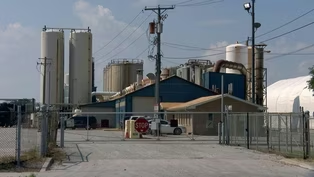
NewState, City File Lawsuit Over Bad Odors at South Side Vegetable Oil Plant
Video has Closed Captions
For some Southeast Side residents, complaints of bad smells have been going on for years. (8m 53s)
 New
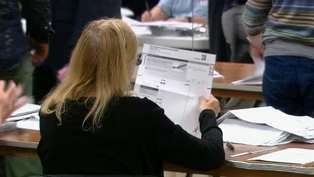
NewSupreme Court Decision on Mail-In Ballots Stirs Confusion. Here's What to Know
Video has Closed Captions
Illinois is now suing the U.S. Postal Service, seeking to challenge an order from the president. (10m 11s)
Providing Support for PBS.org
Learn Moreabout PBS online sponsorship New Episode
- News and Public Affairs

Top journalists deliver compelling original analysis of the hour's headlines.
 New Episode
- News and Public Affairs

Today's top journalists discuss Washington's current political events and public affairs.



 New Episode
 New Episode
 New Episode
 New Episode
 New Episode


Support for PBS provided by:
Chicago Tonight is a local public television program presented by WTTW
WTTW video streaming support provided by members and sponsors.