
Market to Market - June 12, 2026
Season 51 Episode 5143 | 26m 45sVideo has Closed Captions
Market analysis with Mark Gold.
On this edition of Market to Market ... An expanded response to the spread of the screwworm. Indoor farming looks to survive the hype and harvest profits. And, commodity market analysis with Mark Gold.
Problems playing video? | Closed Captioning Feedback
Problems playing video? | Closed Captioning Feedback
Market to Market is a local public television program presented by Iowa PBS
Market to Market - June 12, 2026
Season 51 Episode 5143 | 26m 45sVideo has Closed Captions
On this edition of Market to Market ... An expanded response to the spread of the screwworm. Indoor farming looks to survive the hype and harvest profits. And, commodity market analysis with Mark Gold.
Problems playing video? | Closed Captioning Feedback
Where to Watch Market to Market
Market to Market is available to stream on pbs.org and the PBS app.
Providing Support for PBS.org
Learn Moreabout PBS online sponsorship[PAUL YEAGER] Coming up on Market to Market -- an expanded response to the spread of the Screwworm.
Indoor farming looks to survive the hype.
And harvest profits and commodity market analysis with Mark gold next.
[ANNOUNCER] I wouldn't be here without my customers.
Yeah, I'd like to thank the customers.
They're very dear to our hearts.
It's about the people that you're working with and the relationships that you have.
Thank you.
Thank you.
Thank you.
Thank you from the bottom of my heart.
♪♪ [ANNOUNCER] Tomorrow.
For over 100 years, we've worked to help our customers be ready for tomorrow.
Trust in tomorrow.
Information is available from a Grinnell Mutual agent today.
[ANNOUNCER] Support for Market to Market has been provided by a bequest from Philip Lietz of Alta, Iowa, in recognition of public television's commitment to agricultural programming.
[ANNOUNCER] Market to Market is made possible in part by a grant from the Corporation for Public Broadcasting.
[ANNOUNCER] This is the Friday, June 12th edition of Market to Market, the Weekly Journal of Rural America.
[YEAGER] Hello, I'm Paul Yeager.
Energy is again at the center of economic news and again is showing up in inflation reports.
Let's start with housing.
May was the best month of the year for existing home sales.
The housing market advanced by 3.2% with a dip in interest rates.
The consumer price index added half a percent in May, driven by higher energy prices.
The annual CPI put on 4.2%, the first gain that high in three years.
Another inflation data point the prices before they reach the shopper.
The producer price index climbed to the fastest pace since November of 2022.
The monthly gain was 1.1%, while the annual figure was higher by 6.5%.
Wholesale gasoline was up nearly 70% from a year earlier.
The fight against the New World Screwworm spread across two states this week.
There are seven confirmed cases now of NWS in the United States, six in Texas and one in New Mexico, where the worm was detected and a dog that had recently traveled to Mexico at a battle in the District of Columbia.
As the USDA secretary was again in front of lawmakers, this time in the senior chamber side.
Laurel Bower reports.
[NARRATOR] Secretary of Agriculture Brooke Rollins appeared before the Senate Agriculture Committee this week to discuss the priorities of USDA.
While several topics were covered, the New World Screwworm was at the top of the agenda for border state lawmakers.
[SENATOR BEN RAY LUJAN] Can I just get your commitment that wherever we see this screwworm, those states are going to be prioritized?
Like, now I get what you shared with on the dog in New Mexico or whatever, but Texas and New Mexico have had it.
So, is that a commitment I can get from you?
Wherever this thing starts popping up that moves, that those states up to the priority with responses 100%.
[BROOKE ROLLINS] And that's been the containment effort.
Every model senator showed it would hit our side of the border, Texas and New Mexico by last summer.
So, we've been able to hold it at bay for a year while we've been building out these facilities and staffing up.
But absolutely.
And the president has been very clear this is a nonpartisan issue.
We've got to protect our livestock industry, our hunting industry, et cetera.
So, 100%.
[NARRATOR] Recent Trump administration, workforce and funding cuts spearheaded by the Department of Government Efficiency or Dosage, reduced the USDA overall staff and eliminated essential Central American screwworm monitoring programs.
Critics warn these reductions have delayed rapid response and prevention efforts in South Texas.
[SENATOR AMY KLOBUCHAR] The Animal and Plant Health Inspection Service has lost 25% of its staff, including more than 300 employees and veterinary services alone.
Since the administration came in.
How do you plan on ensuring that each of these critical threats, such as new World, screw Worm, receives individualized resources?
[BROOKE ROLLINS] A year and a half ago, there were ten Aphis employees working full time, a total of ten working full time.
All in.
Now we've got over 120.
So, we've increased the amount of employees in Aphis working on New World Screwworm by 1,000% in the last 14 months.
So, as you can see, we're prioritizing where the big threats are as we're working to, to ensure that we're meeting all of the needs across the country.
[NARRATOR] NWS is a serious pest that threatens livestock, pets, wildlife, and in rare cases, people.
The larvae burrow into the living tissue of animals, causing severe wounds, animal suffering and significant economic losses.
[SENATOR TOMMY TUBERVILLE] Just one question about the screwworm have we opened any of the border in Mexico, either the West Coast or the East Coast to the border?
[BROOKE ROLLINS] No.
The ports have been closed for a year and.
And that allowed us to keep it out.
I think that if we open any of those ports, we would have had it on our side six months, eight months, ten months ago.
[SENATOR TOMMY TUBERVILLE] Are you putting a fly traps or whatever you call them all along the border?
Where are they?
[BROOKE ROLLINS] They are.
They're all along the border.
We have a polygon that gets adjusted every day.
So, on Wednesday of last week, when the calf with the first confirmed case, a three-week-old calf in Texas was confirmed, we within four hours were dropping 8 million sterile flies.
Right on top of that ranch.
And they have had no other cases.
I mean, this just proves the efficacy of the technology.
So yes, we're constantly moving based on where the cases are popping up.
[NARRATOR] USDA is urging any cattle producer who detects Screwworm to report it immediately, saying an infestation is treatable if caught early enough.
The pest was eradicated from the U.S.
In the late 1960s and is not a threat to food safety, according to Secretary Rollins.
For Market to Market, I'm Laurel Bower.
[YEAGER] Biologists will tell you energy, water and nutrients are the essentials every living thing needs to survive.
Farmers would add land and labor to that list.
The building blocks of any successful operation.
Now, even with the right ingredients, economics can be the toughest part of the equation, especially when the operation is indoors.
And Ohio Company believes it has found a way to tip the balance.
It's an indoor farm design that adds some unexpected twists, and they're working to turn controlled environmental agriculture into a profitable harvest.
Peter Tubbs takes us inside the operation in this week's cover story.
[JOSHUA JONES] Every decision that we make along the way is really focused in on what is best for that plant and that experience for the consumer.
[NARRATOR] Salad greens grow under specialized red and blue lighting at an indoor farm in suburban Cincinnati, Ohio.
Controlled environment.
Food production has been a growing industry, but delivered plenty of technical and biological challenges and a scarcity of profits.
But ten years of testing and build out has brought one company to the edge of profitability.
[MIKE ZELKIND] I think 80 acres is the most natural, most efficient way to farm today.
Not just leafy greens, but leafy greens, ingredients, tomatoes, anything you need.
[NARRATOR] 80 Acres Farms has cited its seven farms near distribution hubs of grocery retailers across six states, with a goal of placing clamshells of produce in store displays within 24 to 48 hours of harvest.
The company serves over 18,000 retail locations, with over 1,000,000ft2 in cultivation.
By shortening the supply chain, consumers gain 7 to 10 additional days of shelf life versus produce that has to be trucked thousands of miles from the field.
Most consumers with access to 80 acres farms produce are served by a farm within a two-hour drive.
Extended shelf life has become a key driver of sales in a crowded produce section.
[TISHA LIVINGSTON] We are not just having the ultra-premium shopper.
We're seeing that, you know, moms with families that want to be able to plan a menu but not have to like eat the salad today, but be able to eat it sometime in the next week or even two weeks.
[NARRATOR] Productivity of the farms increases by reducing the variables that can affect crop production, but also accelerating the timetable for growth.
Plants that need weeks to reach harvest on a conventional farm can be grown by 80 acres farms, and as few as 24 days.
[TISHA LIVINGSTON] Agriculture is hard in general, and growing plants is really hard.
I would say that some of the things our philosophy, making sure that we had great tasting, differentiated product that resonated with the consumer.
[JOSHUA JONES] We have these enclosed environments that we have really rigid control over.
So, we're controlling for things like the humidity and the temperature and the air flow, the spectrum of the lights, the intensity of the lights, the amount of grow days that we give, the nutrient levels.
And all of that makes a more consistent product.
[NARRATOR] This farm produces several hundred thousand servings of produce each week, while using up to 95% less water than a conventional farm.
[JOSHUA JONES] Since we have such a short growth cycle, we can turn plants through so much faster that we have a multitude of seasons throughout the year.
[MIKE ZELKIND] And by having a control girls on the grow zone, that is a little different.
You're looking at the yield curves.
You're looking at how crops are growing, and you can modify little things to start perfecting yield, to start perfecting flavor, to start perfecting shelf life, start perfecting nutritional value.
Little changes make a big difference.
[NARRATOR] 80 Acres farms sources seed from established seed producers and leverages tailored growth plans to maximize output.
Field grown produce varieties are often chosen for durability for travel at the cost of flavor and texture.
[TISHA LIVINGSTON] A lot of the leafy greens that we're putting into our blended salads would never make the transit.
They would never make it from California to Ohio and through the supply chain.
And so, we can grow things in close proximity to where it's being distributed.
[NARRATOR] The grow rooms at each farm are completely closed systems.
Airflow is carefully managed, and the grow rooms can create different temperature and humidity zones within each room to match the needs of individual varieties.
The hydroponic growth system delivers water and fertilizer to the plants from below.
The goal is to grow produce from germination to harvest without wetting the leaves, which could lead to fungal problems.
A common problem in the industry.
80 acres farms think of themselves as farmers first, technologists second, which allows for automating much of the manual labor compared to conventional farming.
Germination begins on a compostable medium and starts are soon moved to trays by machine.
Transplanting is now done in minutes versus hours of hand.
Labor.
The transplanter also culls plants that are unlikely to thrive.
Infinite acres, a subsidiary of 80 Acres Farms, is working on standardizing the technology and metrics of the controlled environment, food industry.
Many food, pharmaceutical and consumer goods companies desire ingredients for their processes to be produced near or within their operations, which lowers risk to their supply chains.
[MIKE ZELKIND] Any consumer product, good manufacture, anybody who makes a finished good that has to source raw ingredients.
If they could have a farm literally attached to their manufacturing facility just to grow the ingredients that they have to source globally.
The lack of disruption to the manufacturing facility, the consistency of supply, it's a game changer for a lot of these folks.
[JOSHUA JONES] I love that we're on the we're the tip of the spear in a in a newer industry.
I like that there's not a roadmap for us.
We really have to solve our problems.
We can't rely on other people within a very small industry.
There's not a playbook that we can fall back on.
It takes real life problem solvers to solve the problems that we have.
[NARRATOR] From Market to Market.
I'm Peter Tubbs.
[ANNOUNCER] Next, the Market to Market report.
[YEAGER] Winter wheat harvest hit full stride working around severe weather systems as grains kept dealing with selling pressures and multi-month lows for the week ending July or June 12th.
That is the nearby wheat contract added a nickel and the July corn contract lost a nickel.
Weather is now swinging to the less favorable side of the soy complex.
The July soybean contract declined $0.08, while July meal weakened by 720 per ton.
July cotton fell by $0.58 per hundredweight.
June class three milk futures shed $0.12.
The livestock market was mixed.
August cattle cut $0.47.
August feeders put on 353 and the July Lean hog contract sold off $1.35.
In the currency markets, U.S.
Dollar Index weakened 35 ticks.
July crude oil fell 515 per barrel.
Comex gold was lower by one.
26.50 per ounce, and the Goldman Sachs Commodity Index was off by almost 19 points to settle at 680 30.
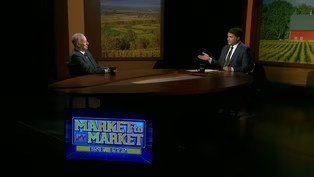
Here now to lend us his insight on these and other trends, is regular market analyst Mark Gold.
Hello, sir.
[MARK GOLD] How are you?
Nice to be back.
Thank you.
[YEAGER] Two weeks in a row.
I have to apologize right off the top, because there's not a lot of green to speak of.
There's not a lot of positive news, but I want to start with wheat.
What's the difference between pre report mark and post report Mark?
Because reading your commentary this week, dramatically different things happen.
What happened.
[GOLD] Well I think first of all we've got the crop progress reports.
When you look at Nebraska and Kansas, Nebraska just by itself poured a very poor is 82%.
Now we only raise about a million acres of winter wheat in Nebraska.
But that's a big chunk.
It is.
And in Kansas, the ratings are not as bad, but they're bad.
Oklahoma is bad.
I just don't think the crop is nearly as out there as much as the market seems to think it is.
But then there's the demand issue.
We don't have any demand for it, but I think that can change here.
You know, the world's in a precarious place with this fertilizer problem.
And, you know, if we carry this thing too far, we're going to have some major problems around the world.
And that's going to lead to food shortages.
So, I don't want to be bearish down here.
[YEAGER] But you also have to be realistic on some things.
So, what is a producer to do right now?
[GOLD] Well, in the wheat market.
Yeah.
Well, you know we've been fairly aggressive.
We've got 40% of our 2006 corn, wheat and beans sold already.
And we're pretty comfortable with that position.
We've got puts on for what we haven't sold.
As usual.
We did buy some call options back a month ago when things looked a lot better, but all right, they're going to lose 10 or $0.20 on a call.
But look at what they've picked up on the cash side.
And look what they picked up on the options.
So, they're in really pretty good shape.
So, you know what's the guy going to do now.
I don't think this is the right time to sell it.
We've already broken hard.
We've got the whole summer ahead of us.
These traders are trading this market like this.
Crops are made.
And I would argue they're a long way from being made out here.
But we had to liquidate the funds.
That was the one thing.
You know, a month or two ago I kept saying these funds are too long, 340 corn, 200 and some odd beans.
They were just long.
Too much stuff.
I haven't seen the Friday commitment of traders reports, but I think they're now out of the corn.
I think they're maybe along a little bit of beans.
There's still long a fair amount of oil.
Still a little too much meal that's been coming down too.
I don't know when it's going to end, but if the weather doesn't change in a hurry, they'll probably liquidate some more.
[YEAGER] We're going to get to weather in a moment, but I want to talk about old crop corn, and that's a question that we received from you at home.
And it's Nathan in Illinois who wants to know what should a farmer with old crop corn do?
Could we see a bounce and what area should we dump the gambling bushels that we normally have, say, in June and July?
[GOLD] Are they gambling bushels, like 3 or 4%, or are they gambling bushels of zeros.
[YEAGER] Yeah.
Yeah.
30 and 40, not three and four.
[GOLD] You know it's a tough situation to be in now.
Can we get a rally?
Sure.
We turn this thing hot and dry, which we can certainly do after the Fourth of July.
We've got a market.
You know, we don't make a corn crop or a bean crop in May and June.
We make it in July and August.
And if we turn the heat up during germination on corn, we're in problems.
And we know that the lack of acres will get the acreage.
In the beans.
But I don't think it's going to be a huge amount.
They've already cut it pretty well.
So, would I try to hold on at this point?
I would, you know, on old crop you're at $4 and change corn.
What I would blow it out down here if I did.
I needed the money.
I'd certainly buy a call option back.
[YEAGER] The old crop situation is interesting because there was a point about six weeks ago where it seemed like it was a good time to sell around Mother's Day, and we haven't gone.
So, if you've held on, you're saying, hold on a little bit more, but I want to talk about another thing here with the market.
And we were not that far away from a 30-month high over $5.
And now we're the lowest price in two years on this new crop situation.
Looking at the weather, looking at the demand side of the equation.
Give me some hope tonight, Mark.
[GOLD] Well, that's a little tough, but I'll try.
You know, I kind of thought, you know, a lot of guys have heard me talk about 1983 when we turned off the rain on May.
On June 1st.
Didn't rain all month, but we still made new lows by the.
The first pick report, the first acreage report on June 30th.
And then we turned hot and dry the first week of July and we took off from there.
We rallied the beans $3, the corn, I think a buck and a half.
And that is certainly possible out here.
They say it's not possible with this extreme El Nino that we're seeing.
It's going to stay wet.
Well, if they're right and it does stay wet, you know, we're not going to produce a great crop.
You need sunshine and too much water is not good.
Beans don't like wet feet.
And from what I'm hearing, we're starting to see some yellowing with all the rain out there.
So, you know, June can be a tough month for the grains.
But I think once we turn the corner and get into the new quarter in July 1st, I think things can change in a hurry, as they usually do, and we can be right back up again.
[YEAGER] So hands in the pockets right now on new crop corn.
[GOLD] Yeah.
I, you know, you're at 440 roughly.
Are you going to go to $4 between now and July 1st?
No, I don't believe that's going to happen.
The funds are out.
So that's taken a big Damocles sword away from this market.
And you know what's going to happen in Iran as of this moment.
And we've heard this moment 40 other times, it looks like we've got a deal.
I don't know if we do or we don't.
If we do, I hope it's a good deal.
If we do, that seems to favor the market, but crude oil has been the real driver out here.
[YEAGER] So yeah.
Well, beans you kind of talked about weather.
Let's talk old crop real quick again.
Same situation.
Are we holding or we've missed our opportunity to sell?
[GOLD] Well, you know, that's why we'd like to have most everything sold on old crop and we're long out of it in the last two months I think.
And we only had just a little bit left at this point, you know, what do you do?
AM I going to tell some guy to sell these kind of lows?
Now you might have to suffer for the next two weeks, but you've suffered enough.
A little more is probably than not going to kill you.
[YEAGER] And you talked about the wet feet for the beans.
At what point does that start to show up in the market?
Because that's a much more realistic thing than a wet cornfield.
[GOLD] Yeah.
I don't think it'll show up until we start seeing some crop progress numbers in July.
That'll show the crops not, you know, 65% good to excellent.
It's 45.
Good to excellent.
And there's some poor and very poor numbers coming in.
But you know, we seem to put heat on it at the right time.
We always have.
I don't know that we've ever really had a major problem because of wet feet.
That means don't like it.
But put 85, 90-degree heat on there with some sunshine takes care of itself.
[YEAGER] But it slows the progress of the crop.
And what's been different the last couple of years is we've advanced.
We've either had it in early, we've had good conditions, and then it shuts off the tap and that changes the situation.
All right.
Livestock for a minute.
Okay.
Live cattle.
You saw the story about the worm.
You've got Canada saying we don't want Texas animals.
You still have the border closed with Mexico.
You also then hear these stories about packers going.
There's just not enough inventory to keep us going.
What's the biggest headline of those in your eyes?
[GOLD] First of all, I don't trust the Packers, so I'll put that one aside.
Certainly, the border is the issue and the cattle.
But I heard a story just two days ago that ivermectin, the same drug that they were using to cure Covid.
In some people, though, it wasn't recommended by the medical profession.
That seems to be helping quite a bit.
So how much farther is this going to go?
I hope not very far.
It certainly doesn't seem to be impacting the price of boxed beef out there.
You're at 394 today.
You know we're not what, $15 maybe off the highs that it's ever been.
So, the consumer demand is incredibly strong.
So, the consumer doesn't seem to be too concerned about it.
But I think the bigger story is what happened on the last Cattle on Feed report, showing finally that shift to more cattle.
And I've been telling guys, I don't know what's going to happen between now and the next six months, but I think when you're at these kind of record high prices in the feeder cattle and you've got strong beef prices out there, you need to be looking at buying some puts to protect the downside, because long term it could be a problem.
[YEAGER] So the feeder market quickly has turned.
But we've said that a lot.
And that's part of the story.
You think right now is what you're saying with the last report.
[GOLD] Yeah I think that's been the driver kind of nobody really wants to talk about it.
I haven't heard anybody really saying anything about it.
But you know, the cattle run in cycles.
And, you know, once we start shifting it kind of tends to run on itself.
[YEAGER] And we've had a little bit of non-seasonal activity in the hog market now too.
This hasn't been performing very well either.
[GOLD] You know, we had some strong prices three, four months ago in the summer month hogs now that we're in the summer month hogs, they've broken quite a bit.
It doesn't look great.
But you know, people are looking for an alternative to cattle for whatever reason.
They're going to go to pork.
They're going to go to chicken.
And, you know, I don't think it's as bad, but the charts certainly don't look good on the hog market, in my opinion.
[YEAGER] All right, Mark, I appreciate your time here on the television show.
You're going to have to stick around for Market Plus.
We're going to put you in the hot seat on one particular item involving you.
[GOLD] Okay.
[YEAGER] Are you ready for that?
[GOLD] I'm ready for it.
[YEAGER] That's a tease.
How about that?
Thank you, Mark Gold.
You've been watching the analysis portion of our program.
In a moment, we're going to continue our discussion in this online only segment.
Find it by searching Market Plus with Mark Gold.
Wherever you get your podcasts, you can also go to our website of Markettomarket.org to listen.
I really want you to do that this week, the Market Insider Newsletter is back in your inboxes each Monday morning with news on this program.
And we also go behind the scenes details that we want to share with you.
Sign up for free at Market to Market .
org next week.
One family's love of farming has cultivated something bigger than the farm itself.
Thank you so much for watching.
Have a great week.
♪♪ [ANNOUNCER] Market to Market is a production of Iowa PBS, which is solely responsible for its content.
[ANNOUNCER] Market to Market is made possible in part by a grant from the Corporation for Public Broadcasting.
[ANNOUNCER] Support for Market to Market has been provided by a bequest from Philip Lietz of Alta, Iowa, in recognition of public television's commitment to agricultural programming.
[ANNOUNCER] I wouldn't be here without my customers.
Yeah, I'd like to thank the customers.
They're very dear to our hearts.
It's about the people that you're working with and the relationships that you have.
Thank you.
Thank you.
Thank you.
Thank you from the bottom of my heart.
♪♪ [ANNOUNCER] Tomorrow.
For over 100 years, we've worked to help our customers be ready for tomorrow.
Trust in tomorrow.
Information is available from a Grinnell Mutual agent today.
Video has Closed Captions
Clip: S51 Ep5143 | 13m 27s | We hear what year stands out and why this year has its own set of challenges. (13m 27s)
Providing Support for PBS.org
Learn Moreabout PBS online sponsorship New Episode
- News and Public Affairs

Top journalists deliver compelling original analysis of the hour's headlines.
 New Episode
- News and Public Affairs

Today's top journalists discuss Washington's current political events and public affairs.

 New Episode
 New Episode
 New Episode
 New Episode
 New Episode
 New Episode
 New Episode
 New Episode
Support for PBS provided by:
Market to Market is a local public television program presented by Iowa PBS