
Sept. 21, 2026 - Full Show
9/21/2026 | 26m 50sVideo has Closed Captions
Watch the Sept. 21, 2026, full episode of "Chicago Tonight."
What’s behind the skyrocketing cost of diesel? And the head of the Smithsonian on his decision to step down amid battles with the Trump administration.
Problems playing video? | Closed Captioning Feedback
Problems playing video? | Closed Captioning Feedback
Chicago Tonight is a local public television program presented by WTTW
WTTW video streaming support provided by members and sponsors.
Sept. 21, 2026 - Full Show
9/21/2026 | 26m 50sVideo has Closed Captions
What’s behind the skyrocketing cost of diesel? And the head of the Smithsonian on his decision to step down amid battles with the Trump administration.
Problems playing video? | Closed Captioning Feedback
Where to Watch Chicago Tonight
Chicago Tonight is available to stream on pbs.org and the PBS app.

WTTW News Explains
In this Emmy Award-winning series, WTTW News tackles your questions — big and small — about life in the Chicago area. Our video animations guide you through local government, city history, public utilities and everything in between.Providing Support for PBS.org
Learn Moreabout PBS online sponsorship>> Hello and thanks for joining us on Chicago tonight.
I'm joined on trend is Freeman will join us later in the program.
Here's what we're looking at.
What's driving the historic spike in the price of diesel and what impact is it having on consumers?
The head of the Smithsonian joins us to talk about his choice to retire.
Clashes with the federal government efforts to preserve history.
There's always going to be risk, especially in a rescue.
And a health update on the rescue beluga whales at Shedd Aquarium.
>> First off tonight, $6 and $0.51 That's what Americans are paying on average for a gallon of diesel.
It's a record high in nearly $3 more than this time last year.
Joining us now to discuss what's behind the increase and how it's affecting consumers are Mike Matt Wells, vice president of the Midwest Truckers Association and Mark Witty, professor of instruction in the Department of Economics at Northwestern University.
Thank you both for joining us.
Mark, I want to start with you.
just mentioned the average price of crude per gallon of diesel sits at $6.
And $0.51 a month ago was $5 and $0.57 in the year-ago, which in retrospect is not that long ago.
>> It was $3.69 Break it down for us.
What's behind the increase?
>> the joke is we always say supply and demand.
And yes, it certainly supply we've seen this disruption of the supply of crude oil coming out of the Middle East.
And that's the basic input into into diesel.
We also some difficulties on the refining level that there's a crunch and that that we work on supply networks that are smoothly, able to take a little from where we expect come from now that's been disrupted.
And so the refineries that are most we just don't have the right refinery network given where oil is coming from now.
And so that's also creating some shortages and driving up prices.
>> And Matt, you've been doing this for a long time.
What's what's your reaction to watching diesel prices soar?
What are other truckers also saying that?
>> It's definitely difficult for the industry right now.
We operate on a on a very small margin by mile.
And whenever diesel fuel takes up 40% of your costs of operating your vehicle and you see those prices increased to levels that we've seen today.
It's definitely making it more difficult for the transportation industry to move things.
And definitely going to cost a lot more money because you know it we're not making money on this.
This is definitely something that's Austin, our industry.
And we have pass those costs on consumers.
At end of the day.
>> I mean, you've been doing this for a long time.
You know, what is the guidance that you give to other truckers right now?
>> What are those comments are right One of the very more most important things on trackers can do is keep an eye on their cost and make sure that they're operating under a diesel fuel surcharge.
Essentially that surcharge allows them to compensate the increased cost fuel on that they're occurring right now.
Hopefully this doesn't last forever by this is going to have some lasting effects for a while.
So they have to be able to adjust the rates to accommodate.
These increases were continuing to see.
>> And mark, last week, the price of diesel jumped to $0.42 Put that into perspective.
How drastic of a jump is that?
>> Representative services pretty big end.
I mean, I think fuel Getting him and hear him to sing fuels with 20%.
lot of transport.
We've got cars and trucks.
Trump has a labor but fuel is.
>> Is the heels of a percentage can be upwards of 40 to 50% of the actual depending on depending on what you're hauling.
How have you are and where you're going and can it can benefit your very much in the marketplace for it for a long haul to Mr.
General Ban Truck semi 1.20 EUR to 25% of your actual rate is fuel.
And when you're seeing that rate increased 50, 60 70%, that adds up very, very quickly.
>> I was talking about the fuel, fuel surcharge.
My understanding is, know that you're gonna make it was just a few planning when and how to get it to market and see his long-term contracts.
You guys can't guarantee a price because no feels going to cost you work in there.
That if you'll get sense of that and the price is going to go up because if you're making a profit but to survive to pass along and soon that works its way to the cost of avocado and snow tires, everything So we got your question.
I liked fuel prices jump by that works into consumer prices.
Pretty quickly.
>> Yeah, it?
No.
Go ahead.
Yeah, it does that in very, very quickly to to consumer prices and where, you know, it's a fundamental cost of >> moving things and you throw out on top of the Exxon Mobil plant last week being down for for 7 days.
That supplies almost 78% of the Midwest fuel supply on top of the global markets.
You mentioned earlier, Mark, is it's just a you know, it's it's almost a comedy of errors a lot of ways that keeps creating this scenario.
And we're seeing eye as these will be prices ever seen history.
>> And mark, you know, President Trump has set out to cast blame on energy facilities hit as part of the Russia-Ukraine war for the increase.
He wrote on the truth Social last week.
The Worlds Diesel price rises mostly caused by the Russia-Ukraine war, not Iran.
What's your reaction to that statement?
>> I would with a mostly I mean, it is was putting it like trying to get goods from where the remains were.
There we were there you see United States, but it really isn't.
It is a worldwide market and worldwide market for crude is very expensive.
And that's the again, the major input into diesel fuel.
Certainly Russia is a big producer diesel fuel big freeze of oil be refined.
Lot of these only use a lot easily sell to your and Ukraine is making life tough for a show with their energy sector.
But I think that isn't that's not as Siro contribution to.
The big thing is just the cost of oil Ponce.
Leaving the ball.
Seeing that.
You see it for gasoline.
Use it for years.
The cost of a barrel.
And that's the big Costa.
That's a big sources.
Cause stress.
>> They met.
Are there any types of relief you would like to see whether from the Trump administration from the state of Illinois for truck drivers.
>> Well, we we always encourage a state of Illinois has some higher fuel taxes in the nation.
We have a road fund that is very, very well funded.
The state has the ability and our governor has the ability to.
But more than just a pause on and increase.
But actually slow down the motor fuel tax for a while to help.
>> Relieve a little bit of that pressure that we're seeing, I think without much of a detriment to the state of Illinois, the Legislature has ability to do so and we'd love to be able to see them step out make some changes in the short term.
Not only how our industry, but to help everyone in the state of Illinois is again.
This is the fundamental price everything.
Everything you buy shows up on a truck one way or another.
And diesel fuel weighs so much into what you're going to pay for your groceries and Thanksgiving and your Christmas presents.
This is going to have a profound effect because when prices go up, they don't go down as quickly as they go up.
No matter how you do And, you in some sense, everyone's everyone's feeling it.
I do want to ask you at the rise and diesel prices comes after the Illinois Tollway board approved.
>> A 30% commercial vehicle toll increase.
That increase goal goes into effect next year in January.
What would be the effects of record high diesel costs combining with the toll increase.
>> You're looking at just more cost to deliver goods to the people Chicago.
Chicago Land area.
That wasn't there a few months ago.
And, you know, you continue to compound these things and people are going to eventually say I've had >> And mark, at what point could we see these prices come down?
>> That is a very tricky question.
The margin between what oil costs and diesel costs really spread.
I think some of us are finding I believe is remarkably don't quite know what that is.
And as certain level prices almost as high when Russia invaded Ukraine a big It came down fairly quickly.
This one seems to be much more.
Persistent that I think that people are always for a long time to come.
We're going to be quite concerned about whether one will continue to flow through the various streets.
And that is that sort of put the risk premium on on everything that will be there a higher price?
Because we don't know when solely that happen get turned off.
As I was pretty I think it net flicks.
Movies are so have a hard thinking want to buy that doesn't come on a truck.
And yes, everything's up and I know what get paid what things cost.
And so many the only important thing he'd been reason wages went so they can maintain the lifestyle.
then a living last few years of this can definitely Martin, back to Everyone this is deft.
This definitely can affect every we're going to have to leave it at that.
Thank you both for your input.
>> Thank you, Matt Wells and Mark witty.
Up next, Brenda's Freeman in the head of the Smithsonian on current tensions with the federal government and his decision to retire.
>> Chicago tonight is made possible in part by the Alexander and John Nichols family.
The Pope Brothers Foundation.
And the support of these donors.
>> Our next guest knows a thing or 2 about history as he's made a fair bit of it himself.
Lonnie Bunch has led the Smithsonian Institution since 2019.
He was the first African-American and the first historian in the position overseeing 21 museums, the National Zoo, several libraries and education and research centers.
He recently announced that he'll be stepping down at the end of the year.
His decision comes amid ongoing battles with the Trump administration.
And joining us now with more is Lonnie Bunch.
Before his time at the Smithsonian, he served as president and director of the Chicago Historical Society now known as the Chicago History Museum Secretary.
Welcome back.
Thank you for joining us.
>> Thank you.
Always love to be back in Chicago.
>> So in a statement you when announcing your retirement, you said that you are doing so with, quote, mixed emotions.
Why mixed?
What what are some of those emotions?
>> some ways love this was It's where it's been almost 40 years of my career and Mike, my new is always want to be there, too.
Hope the Smithsonian Protect the Smithsonian support.
This wasn't me.
So what's really with mixed emotions are moving.
So if they're most 40 years, it's time.
>> It's time.
I have to ask, of course, if the president's efforts to influence the museum have impacted your decision at all.
>> be honest, I stayed longer importantly because it wanted to protect the Smithsonian.
>> Recently, the Trump administration has requested an investigation into the Smithsonian and threatened to withhold federal funding just last week it announced plans to add temporary signs warning visitors of, quote, radical ideologies outside of some buildings.
What do you make of the president's attacks on museum?
>> You know, don't know why this is being done.
I can tell you is that the Smithsonian is driven by scholarship.
2, 3, its job in some is to be reservoir of history or culture that the public can dip into for clarity.
can do for understanding for a little bit of hope.
So for me, this new series always been this amazing places 80 years.
It sued.
America.
Want is continue to do that in the future.
>> Do you think any of these actions are an attempt to rewrite history >> I think that there's always the debate over what's accurate history and we believe what we to Zachary history.
I think it's important.
There's discussion whom you to complex story to cool.
Difficult stories.
I think in some ways you can understand America.
We understanding how much we with challenges.
I think that I don't see these American spirit.
We see these away.
America is trying to live to the ideals of the Jefferson of the weekend.
struggle.
That's to but it gets better.
So for me, understanding the complexity, the pain.
this really understand how we as a nation have evolved in grooming make better?
>> Before becoming secretary of the institution, the Smithsonian, you're also the driving force behind building developing.
And then, of course, becoming the first leader of the National National Museum of African-American History and Culture.
Why did you think it was important to have a physical space to honor African American history and that that physical space be under the Smithsonian versus any other museum organization in the country.
>> Well, I think first of it was important to recognize that America's history is too big for one bill and that American story is both a story of the community, but it's also a story of the nation.
So I wanted to be part of this is Sunni.
And because here is where millions of people will come to explore questions, issues, exhibits that they may doing their own time, but because it come to the Smithsonian, it's a great educational opportunity.
We think the fact sure 2 million people have been to that museum where it it's so for me, it really meant this was a chance to say.
the mayor the Mall of America is where the world comes, understand what it in America.
And you can understand interstate.
It could complexity of the African-American experience.
So for me, this was just a wonderful opportunity to make sure that when people come to watch, you can become part of this was to it to understand the fullness of the store.
>> You've served as the secretary of the Smithsonian for 7 years, of course, and in different roles over over the years.
But during the 7 Secretary, you have seen her country deal with the global pandemic.
The Black Lives Matter movement, a polarized political climates and threats to art and culture driven by artificial intelligence.
How do you navigate those challenges will also thinking about how those events are going to be recorded in history.
>> Well, think first of got to remember sometimes a signal krishnamurthy this, too.
there's no doubt this has been a challenge to 7 years.
So I think part of what we wanted to do was really to levels.
One how do you protect this was soon as the Smithsonian Protective staff during pandemic as this mystery and continue to serve the public with its museums record.
So it really thinking creatively about how to make sure we serve the public and then it's important to recognize part of the job of the museum is the cooler today for 2 more So I want to make sure that we call it that the pandemic.
We wanted to make sure things we collect.
It was my daughter was an emergency medicine in turn in Chicago.
So we collect diverse groups that she wore during the pandemic.
We wanted to make sure that every aspect, whether it's about the political partisanship, whether it's about Black Lives Matter that was would be collected.
So that is sort of the fusion will have much to be able to the stories that will really help people understand what it was like in this period.
>> And of course, we know that, you know, you spent some time in Chicago running what is now known as the Chicago History Museum.
How did your time in Chicago help repair due to leave the Smithsonian later?
>> Chicago's defense, there's no there.
There.
First of all, it's going really rich complex history.
You know, it's a city of neighborhoods each Tuesday, which history.
So it was really fascinating to figure how life together for the you make sure you explore different communities.
Different areas but be able to save Minot together, understand what it means to be a skirt.
Well, so I think that Chicago took me a lot about politics me.
Good Politics and compared to Chicago.
It's so in many ways, Chicago to let me have to be fundraiser to be that leader is my first time really in museum.
So I give a lot of credit to the city of Chicago to the way the city embraced me me about this, and basically said you've got good use instrument.
All >> It's Chicago also celebrated another major museum milestone with the opening, of course, of the Obama presidential center over the summer.
What are you hopeful people will take away from that landmark.
>> Well, think presidential libraries and senators to really be president said do want live very well.
That story is really is a bigger story.
Understand the mayor had new generations understand the political system.
do you make sure that the Obama library is as much about helping America?
Because it is remembering a lot.
I think that's one of the powerful things that the La River.
>> there's a decline Secretary museum visits and financial investment with the rise of the digital era.
How do you encourage people to appreciate history and understand the significance of museums?
>> Well, I think that what I see is while for people who want to deal with everything to the digital Also, when I talk to younger Americans, they also recognize they want to see city that they grew up in a digital world and to see the real object real story.
think that's really part of the appeal of these museum.
But also you see him doing it's a social experience.
So rather than individual online museum, you're going engage with people.
You don't And look at an object can certainly think of in different because the conversation should here zoo will always play this crucial and I think museums in many ways reported the glue that holds communities to give.
So it's incumbent upon museums just talk about why they're important to the city, what they hope the city understand when I was in Chicago retaken by the museum's in the near 90 museums.
talk a lot about.
Here's how we help.
The city putting hits.
is unreal to understanding science or history so important that Israelis making the argument.
Why are these museums port?
>> You've said that you will stay in your current role until the end of the year as the search continues for your successor, what kind of experience and personality do you think it takes to fill this role?
>> I mean, I think that what you want is somebody who understands the system who cares about the fact that it's really be in Non-partisan sight of now, is really tried to increase and issues.
Now a strategist 180 years.
Also when somebody who cares passionately about working the political system to protect the institution or a need to understand to do that.
You know, you want to somebody who sort to say when all else fails, blame the guy before.
>> couple seconds left.
Mister Secretary, what's next?
What you hope to accomplish before you leave?
>> You know, I want to knew zooms around the world tell the stories they want probably do.
Little teaching is some universe that may want to hire me.
But the real Julie's, I want to spend time with my grandkids that live in Chicago.
So that's really the key for me.
Spending more time to >> Excellent.
We love to hear it.
So you'll give us a call.
Next time you're back in town.
Smithsonian Secretary Lonnie Bunch.
Congratulations.
Best of luck.
Thanks for joining us.
>> Thank you very much.
>> And we're back with more right after this.
>> Reflecting the people and perspectives that make a buck This story is part of Chicago tonight.
Black Voice.
>> Janell Roller coaster the last 3 months at the Shedd Aquarium and it took another sad turn today this evening.
The shed is reporting the death of a 4th beluga.
Well, 26 year-old name all Cyrus, who was part of the first pond for females brought to Chicago back in July.
The shut took in a total of 10 blue bus from a close Marine Park in Canada.
Our Patty, what Lee spoke with the sheds lead veterinarian just last week to get an update on the health of the whales who remain under careful observation.
>> There's always going to be risk, especially in a rescue.
And we do everything we can to mitigate that risk.
But it is still there.
They lived in one place with one way of interacting with humans and with each other for in some cases, multiple decades, then they're moved to a new facility with different humans, different animals and a little bit of a different way of life.
So we're trying as much as we can to make.
The transition as slow as possible.
But of course, the actual move from Canada to the AZ facilities.
Is a large.
>> Some animal rights activists opposed the whales captivity and their transfer.
That criticism grew louder after 2 sheds, newcomers died along with one of the claims resident the Lucas.
>> It's devastating deeply, deeply personal.
this is giant group of people dedicated their entire lives to the love of these animals.
>> But Dr Tang says circumstances at Marine land including crumbling infrastructure and water, quality issues made the rescue urgent and absolutely necessary.
>> It is not a marker of the people who spend every day with those animal, the humans, the care takers caring for these animals cared for them very, very much.
But there were concerns they were at the end of their line in terms of resources.
So there was no other option for these whales.
It was either find a new home for these an ice.
>> Dr Tang says it's too soon to know what caused the deaths of peek at you and rain who arrived in July as well as Beethoven.
A longtime resident.
>> A economy crops.
The exam is is very complex and involves a lot of different people.
And it's sort of like a jigsaw puzzles.
So we want to wait until we have as much information as possible before we share anything.
>> That hasn't stopped speculation from swirling that blue cause may have been sick and carrying diseases when they arrived.
That shed Dr Tang shot down those rumors.
So any time an animal moved, including in this rescue situation, we run a panel of tests that cover infectious diseases are things that we're worried about bringing in too.
>> Another facility and they were negative for all of those really big infectious diseases.
>> Dr Tang says the focus continues to be on the well-being of the cause.
She says the whales are being monitored around the clock with staff paying particular attention to things like a change appetite.
>> When we say day by day, hour by hour, we truly mean that they're all on a different path.
I think we have months before we take a to be totally honest.
This is going to be a long process of acclamation.
Yes, we still have 24, 7 monitoring.
Guess our phones are constantly on at all hours of day and night.
And so it really looks like we're asking, what is today look like?
What tomorrow look like?
It's really about survival and triage and wanting these whales to thrive.
>> While there have been low points in the journey, Dr Tang says there have been moments of joy as well.
>> I think the moment of reuniting those 2 groups of females that lives together.
Marineland was really, really beautiful and watching how they greeted each other and Brogdon each other like oh, my gosh.
same thing happen to you.
The privilege of spending time with them.
The privilege of getting to know them every day is a highlight.
>> For Chicago tonight, I'm patty.
>> And the wells deaths all being examined 10.
The shed says they will share more when those findings confirmed those blue as are quite beautiful.
And that's our show for this Monday night.
Sign up for our free email newsletter.
Urban nature to stay up to date on environmental news.
Information on local wildlife and much more.
That's at WTC W Dot Com Slash newsletter and join us tomorrow night at 5, 30 10.
We break down the 2 competing renters ordinances.
They're up for a major city Council vote this week.
now from all of us here, Chicago tonight, I'm joined none this.
Thank you for watching.
Stay healthy and safe.
Good night.
>> Closed captioning is made possible by Robert a and Clifford law, offices of personal injury, law firm that
 New
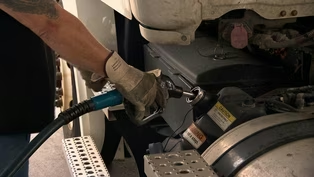
NewHow Skyrocketing Diesel Prices Are Impacting Consumers
Video has Closed Captions
The national average for diesel has climbed to $6.51 a gallon, according to AAA. (8m 46s)
 New
NewShedd Aquarium Vet Says Rescued Belugas Remain on 24/7 Watch
Video has Closed Captions
The aquarium took in 10 whales from a defunct Canadian marine park. Three of those whales have died. (4m 1s)
 New
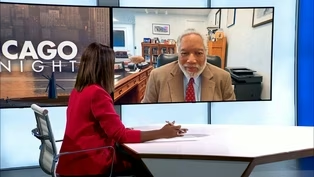
NewSmithsonian Secretary Lonnie Bunch on Retirement, Clashes With Federal Government
Video has Closed Captions
Lonnie Bunch knows a thing or two about history, and he’s made a fair bit of it himself. (10m 39s)
Providing Support for PBS.org
Learn Moreabout PBS online sponsorship New Episode
- News and Public Affairs

Top journalists deliver compelling original analysis of the hour's headlines.

- News and Public Affairs

FRONTLINE is investigative journalism that questions, explains and changes our world.
 New Episode
 New Episode
 New Episode
 New Episode
 New Episode
 New Episode
 New Episode

 New Episode
 New Episode
Support for PBS provided by:
Chicago Tonight is a local public television program presented by WTTW
WTTW video streaming support provided by members and sponsors.