
True Crime Fact or Fiction
Clip: Season 8 Episode 3 | 5m 8sVideo has Closed Captions
Michael Connelly credits his LA crime reporting experience as the foundation of his fiction writing.
Michael Connelly praises authors like Raymond Chandler, Joseph Wambaugh and Ross McDonald for his adoration of Los Angeles from afar. Once moving to the city, he found rich, colorful stories in the diversity of this city. Deeply intertwined, his career as a reporter informs his fiction work; in fact, his first published novel was actualized in part because of his access to detective briefings.
Problems playing video? | Closed Captioning Feedback
Problems playing video? | Closed Captioning Feedback
Lost LA is a local public television program presented by PBS SoCal
True Crime Fact or Fiction
Clip: Season 8 Episode 3 | 5m 8sVideo has Closed Captions
Michael Connelly praises authors like Raymond Chandler, Joseph Wambaugh and Ross McDonald for his adoration of Los Angeles from afar. Once moving to the city, he found rich, colorful stories in the diversity of this city. Deeply intertwined, his career as a reporter informs his fiction work; in fact, his first published novel was actualized in part because of his access to detective briefings.
Problems playing video? | Closed Captioning Feedback
How to Watch Lost LA
Lost LA is available to stream on pbs.org and the free PBS App, available on iPhone, Apple TV, Android TV, Android smartphones, Amazon Fire TV, Amazon Fire Tablet, Roku, Samsung Smart TV, and Vizio.
Providing Support for PBS.org
Learn Moreabout PBS online sponsorshipMichael worked the crime beat of the Los Angeles Times, mastering how to chase leads, cultivate sources, and earn the trust of cynical detectives.
Today, he brings that journalistic precision to his fiction.
With 39 novels and several hit TV adaptations, including "Bosch" and "The Lincoln Lawyer," Michael has constructed a literary universe that feels as authentic as the city it portrays.
So, there's true crime.
There's also crime fiction.
And these are obviously distinct genres, but there's some relation there.
How does your background as a crime reporter for the L.A.
Times-- how does that inform your work as a writer, not just of detective novels, but also of television?
Michael: In every way and all the time.
If I had not worked a crime beat for a newspaper telling true stories, I wouldn't be doing what I'm doing now, because it's kind of the foundation.
So, you wrote two mystery novels that were never published, before you moved to L.A.
Right.
And then you moved here, and the first book you wrote here was published.
Was there something about being in L.A.
that unlocked that for you?
I think it was.
I loved L.A.
from afar, and books and film, like "Long Goodbye," "Chinatown" are my favorite movies.
And when I saw "Long Goodbye," that led me to the books, Raymond Chandler's, and-- Nathan: Masterful books.
Yeah, and then there's Joseph Wambaugh and Ross MacDonald.
These were the people that made me want to become a writer.
All those guys have written-- wrote in different times, and I think, you know, the diversity of the city and its issues at the same time are really what I try to capture when I put that in a framework of-- usually a homicide investigation.
And I've gravitated towards cold-case unit, because these are time-travel cases.
They're very contemporary because of what they're doing now, but the case takes them back in history.
Your first book was-- if I remember correctly-- it was based on or inspired by a true-- an actual true crime.
Yeah, I mean, it's funny.
I came out here in 1987.
I was 30 years old.
I had tried to write two novels where I grew up in Florida.
And I was missing something, so I decided to change my life.
And I moved all the way across the country and took a job here in L.A.
And on the very first day I arrived, there was this big heist, where guys in the ATC-- three-wheeled motorcycles, went through the tunnels underneath L.A.
and then drilled up into a bank and took everything.
And it was never solved, to this day.
And, immediately, I thought, "This could be something I could try with my third novel."
And I was able to get my way into a briefing where detectives were telling other detectives how they did it.
And so, I got all the details, and that became the basis of my first published novel.
So, you started working on your first published novel at the same time you started working for the L.A.
Times.
Yeah, yeah.
Nathan: Wow.
So, these two careers are really intertwined.
Oh, yeah, I mean, I wanted to write crime fiction first, and with some advice from my parents, I went into journalism.
To me, my days as a reporter, they added up to 14 years, but still, they were days of research.
So, there's journalism embedded in your fiction?
I think so.
I mean, I hope so.
I had a press card that gave me access when I first started my career.
That was several years ago that I left being a working journalist, but I've kept access, and I use a lot of real people, and I gather stories all the time, true stories.
And then, if I have any kind of skill, I think it's determining what those stories mean or what their thing is.
Is it an anecdote?
Is it a chapter?
Is it a whole book?
But, usually, there's something-- there's truisms that are the starting point for all my made-up books.
So, one of the remarkable things about your work is it doesn't traffic in all these cliches about L.A.
I mean, I imagine that some readers, they'll pick up your books for the first time, they'll look in the back, and they'll see, "Oh, it's about a Hollywood homicide detective."
And they might think it's about something else, but then when they open up the book, they see the real L.A.
There's so many things going on.
There's so many things to choose from.
Why go down that road of the Hollywood tropes?
So, how do you choose locations for your book?
Well, I'm always looking for a new location.
You know, I'm never going to run out of places to write about in this city, but I'm always looking for something unique, something where-- I haven't hit before.
I had a guy fall off the roof of that building in one of the books.
Nathan: Right here?
Michael: Yeah, in my latest book, I, for the first time ever, go to Angelino Heights.
All my books, at some point, are in L.A.
Nathan: Yeah.
So, everywhere you drive in L.A., there have to be-- there are fictional murders or fictional cases that... I mean, there's a Michael Connelly landscape here.
It was interesting.
I thought this was public transportation, so I didn't check with anybody, and I wrote a book called Angels Flight where there's a double murder on there, and-- the book comes out, and I'm signing books, and somebody puts down a business card in front of me, and it says "Executive Director of Angels Flight."
And it turns out this is-- even though it's over 100 years old, it's always been kind of operated by private operators.
So, I guess, technically, I should have asked for permission to kill somebody on there, but they thought it increased ridership, so I skated on that.
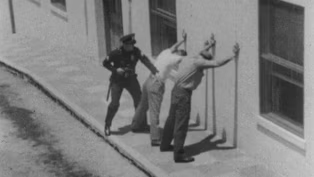
Preview: S8 Ep3 | 30s | Discover how the True Crime genre was shaped by its deep historic legacy in Los Angeles. (30s)
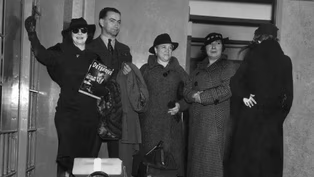
True Detective Helps in the Black Dahlia Case
Video has Closed Captions
Preview: S8 Ep3 | 1m 29s | True Detective Magazine was used as a tool to help hunt down the Black Dahlia murderer. (1m 29s)
Providing Support for PBS.org
Learn Moreabout PBS online sponsorship









Support for PBS provided by:
Lost LA is a local public television program presented by PBS SoCal